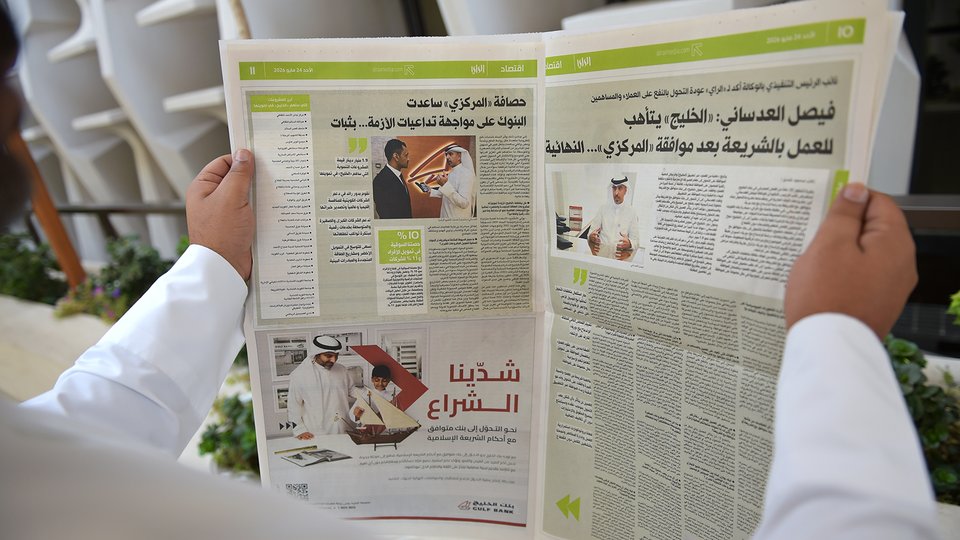
24/05/2026
Faisal AlAdsani: Gulf Bank is preparing to operate in accordance with the principles of Sharia, following the final approval of the Central Bank
The Acting Deputy CEO confirmed to Al Rai that the conversion will benefit both customers and shareholders
- Central Bank of Kuwait’s prudent measures helped banks navigate the recent crisis with resilience and stability.
- Conversion requirements are being fulfilled in line with the regulatory frameworks and the deadline ending in August.
- Due diligence appraisal for the merger with Warba is nearing completion.
- Two clauses were added to customers’ contracts to include their consent to convert their transactions to a Sharia-compliant format once we obtain final approval
- We have approached a segment of customers and obtained consent of a large percentage; we invite the rest to consent through the App.
- There will be no negative impact whatsoever on the customers after conversion; they will continue to enjoy all rights and privileges under their contracts without any additional financial burdens.
- Gulf Bank contributed to financing development projects worth KD 1.9 billion.
- We play a leading role in supporting Kuwaiti companies to compete regionally and globally and to export their expertise.
- We support major companies and SMEs by providing them with innovative digital services in line with their expectations.
- We prioritize expansion in green finance, renewable energy projects, and environmental initiatives
- We have activated our business continuity and risk management protocols and succeeded in ensuring uninterrupted operations.
Over 22 years of experience in banking at Gulf Bank, Mr. Faisal Al-Adsani, the Acting Deputy Chief Executive Officer, discussed Gulf Bank’s two strategic ongoing projects: the planned conversion into a Sharia‑compliant bank and the potential merger with Warba Bank.
In an exclusive interview with Alrai Newspaper, Al-Adsani commended Central Bank of Kuwait’s initiative and prudent measures introduced to help banks navigate the recent crisis with resilience and stability, highlighting that Gulf Bank has successfully maintained uninterrupted system operations and continued delivery of services.
Commenting on the recent geopolitical conditions in the region and their impact on Gulf Bank’s performance, Al-Adsani stated: The global markets operated in an exceptionally challenging environment in the first quarter of the year, however, the State’s institutional strength and coordinated policy response have supported prompt continuity of economic activity. He commended the initiative of the Central Bank of Kuwait and its prudent measures, which had a great impact in helping the banking sector steadily face the impact of that crisis.
As for Gulf Bank, we have swiftly activated our business continuity and risk management protocols in line with the established frameworks and regulatory directives This ensured uninterrupted system operations and enabled seamless, secure transactions for both individual and corporate clients. These efforts were supported through the bank’s Mobile Application, Interactive Teller Machines (ITMs), and branch network, all operating in compliance with national requirements and security standards. Despite challenging circumstances, Gulf Bank achieved a net profit of KD 9.4 million in the first quarter, consistent with the same period in 2025, while recording a 4% increase in operating profit.
Conversion and Merger
Regarding the two projects : Gulf Bank’s conversion into a Sharia-compliant bank and its merger with Warba Bank, Al-Adsani stated that despite the challenges, airports closure, and the fact that some of our consultants and employees were abroad at the onset of the crisis, the Bank successfully maintained uninterrupted operations, and therefore our ongoing plans regarding the conversion of the bank into a Sharia-compliant bank, as well as the appraisal of merger with "Warba", are proceeding according to the set schedule and in accordance with the regulatory requirements.
With respect to our planned Islamic conversion for Gulf Bank, we are still making progress in line with the established timetable and regulatory frameworks after obtaining the initial approval from the Central Bank in August 2025. We are working diligently to fulfill all requirements within the regulatory deadline, which expires at the end of August 2026. In the meantime, Gulf Bank continues to maintain business‑as‑usual operations while preparing for the next phase, subject to final approval from the Central Bank.”
As for its merger project with Warba, the appraisal is still ongoing and the due diligence phases are nearing completion under the supervision of independent consultants, as well as under the supervision of both the Board of Directors and the competent regulatory authorities. This project is also proceeding in an orderly manner, and any future developments will be announced as per disclosure requirements.
Customer Consent
Regarding the fulfillment of the customer consent for the conversion to Sharia-compliant banking, Al-Adsani explained: “Since Gulf Bank obtained the initial approval of the Central Bank in August 2025, two clauses have been added to the contracts for financing, deposits, bank accounts and other services, to include customers' consent to convert their transactions to Sharia-compliant formats once we obtain the final approval.
We also approached one customer segment through our mobile App and SMSs to consent to the bank's transition into Islamic banking in line with the regulatory requirement conditional for final regulatory approval. In fact, a large percentage of these customers expressed their consent. To that, I would like to convey my appreciation for their support to the bank's strategic decision, noting that we will be gradually communicating with the remaining percentage to obtain their consent digitally through Gulf Bank’s Mobile App.
Customers & Shareholders
Regarding value creation to both customers and shareholders that will result from Gulf Bank’s conversion to a Sharia-compliant bank, Al-Adsani affirmed that the conversion of Gulf Bank into a Sharia‑compliant institution constitutes a strategic initiative with broad benefits across stakeholder groups. For customers, the foremost assurance lies in the conformity of their financial transactions with the principles of Islamic Sharia. A significant segment of customers perceives Islamic financial products as offering fair financing and investment alternatives, predicated upon profit‑and‑loss sharing mechanisms. Equally, the conversion carries substantial value for shareholders, as it facilitates access to a wider investor base and reinforces corporate stability. The global and regional momentum of Islamic banking further amplifies these advantages, providing shareholders with enhanced prospects for sustainable and long‑term returns.
Rights and Privileges
Commenting on any potential impact on customers arising from the conversion of Gulf Bank’s existing products into Sharia‑compliant offerings, Al-Adsani confirmed that there will be no negative impact on the customer whatsoever after conversion. Customers holding accounts, loans, credit cards, deposits, or similar instruments will continue to enjoy all rights and privileges guaranteed under their current contractual arrangements. The conversion entails the provision of identical services, but they will be restructured in accordance with Sharia principles. There will be no additional financial burdens to customers as a result of the conversion.
Development Projects
Addressing the national role of Gulf Bank as a key financier of major development initiatives, Al‑Adsani stated that since its establishment 65 years ago, development financing has remained a cornerstone of Gulf Bank’s strategy. Over the decades, the bank has assumed a pivotal role in advancing national projects—whether directly through financing large‑scale ventures in energy, infrastructure, and housing, or indirectly by supporting domestic enterprises engaged in execution. Within this framework, the Bank reaffirms its enduring commitment to actively contribute to the construction of Kuwait’s economy, to play a substantive role in realizing Kuwait Vision 2035, and to assume leadership in embedding the principles of environmental, economic, and social sustainability.”
He elaborated that when the Bank undertakes the financing of major development projects, its role extends far beyond the mere provision of credit facilities. Rather, it mobilizes the full breadth of its institutional resources to ensure the successful execution of projects in accordance with the established plans. In addition to extending credit support, the Bank also delivers investment and technical services, encompassing both financial and lending expertise and engineering capabilities.
Notably, Gulf Bank has distinguished itself as one of the first local banks to establish a dedicated team of Kuwaiti engineers tasked with evaluating large scale contracts financed by the Bank, and producing periodic reports and studies that assess the trajectory of Kuwait’s development.
Key Sectors
With regard to key sectors currently prioritized by the Bank in financing development projects, Al‑Adsani stated that the Bank has supported a wide array of major initiatives across diverse domains—including entertainment and culture, healthcare, oil, housing, infrastructure, and other critical areas that constitute pillars of the national development plan. The value of projects financed by Gulf Bank during the most recent phase amounted to approximately KD 1.9 billion.
He further added that recent years have marked a giant leap, evident not only in the scale and volume of projects but also in their nature, particularly through the growing dominance of Public‑Private Partnership (PPP) projects. Based on this new national approach prioritized by the State, Gulf Bank has assumed a pivotal role in financing such projects, whether by extending credit to principal contractors and developers or by supporting subcontractors and local suppliers.
Small and Medium Enterprises (SMEs)
With respect to the share of Small and Medium Enterprises (SMEs) within the Bank’s portfolio, Al‑Adsani confirmed that, alongside its financing of large‑scale development projects across diverse sectors, Gulf Bank accords significant priority to supporting Kuwaiti entrepreneurs, reflecting the Bank’s conviction that encouraging the SME sector is integral to the realization of Kuwait Vision 2035, which seeks to diversify income sources and reduce reliance on oil revenues. By extending financing to these enterprises, the Bank contributes to the construction of a more resilient and sustainable economy, particularly given that SMEs constitute a critical engine of job creation for young entrants into the private sector workforce.
Co-Financing
Highlighting Gulf Bank’s complementary role alongside other local banks in co‑financing, Al‑Adsani stated that, beyond the financing solutions and credit facilities extended to expedite the implementation of the country’s strategic projects, Gulf Bank assumes an active role—whether independently or under the auspices of Kuwait Banking Association—in collaborating with public and private entities to study and evaluate ongoing projects in Kuwait. He underscored the Bank’s commitment to working closely with relevant government entities to ensure the successful fulfillment of national development plans.
Furthermore, recognizing the critical importance of the country’s major development initiatives and in compliance with the Central Bank’s directives concerning diversification of credit risk and credit concentration, Gulf Bank is keen to involve other local banks in project financing, particularly for high‑value ventures that naturally necessitate substantial cash and non‑cash facilities, which could otherwise elevate the credit concentration of the executing entity.
Support for National Companies
In addressing Gulf Bank’s role in supporting national companies to compete with foreign firms in the execution of development projects, Al‑Adsani stressed that Kuwaiti banks—and Gulf Bank in particular—regard the empowerment of domestic enterprises as the cornerstone for advancing sustainable development. Accordingly, we are committed to delivering innovative financing solutions tailored to the specific needs of national companies, thereby enabling them to compete effectively with foreign firms in the execution of development projects. At the same time, we believe that healthy competition with international companies serves to elevate efficiency and quality standards. This conviction drives us to empower national companies by equipping them with expertise, financing instruments, and advisory support, thereby positioning them with the capacity and resilience to lead projects that advance the national economy.
He added that Gulf Bank plays a leading role in enhancing the capabilities of Kuwaiti companies to compete regionally and globally, enabling them to export their expertise abroad by securing major contracts across the Gulf region and beyond. These achievements underscore the strength and potential of Kuwait’s private sector, which the Bank views as a true partner in attaining national development goals.
Financing Challenges
In addressing main challenges currently confronting banks in the financing of large scale development projects, Al Adsani said: In general, Banks face an intricate set of challenges when financing major development projects, and these challenges are imbedded in the nature of these undertakings. The first one is credit risks, as the execution of some projects spans several years, which increases the likelihood of default or reduces the repayment capacity of some executing entities.
The second challenge arises from the volatility of oil prices, given the heavy dependence of regional economies—including Kuwait—on oil revenues; fluctuations in prices or disruptions in production and export directly affect government expenditure and, consequently, the demand for financing.
The third challenge pertains to execution risks. Costs may exceed the planned budget, or timelines may face delays due to issues in the supply chain or management, in addition to the risks of adopting untested technologies or poor coordination among stakeholders, as well as disputable environmental and social risks; legal and organizational risks resulting from changes in policies or regulations. Hence, banks strive to address these challenges through rigorous financial analysis, employing digital transformation to accelerate cash flows, and activating risk management tools to ensure project sustainability and success.
Moreover, banks have to deal with broader economic and financial variables, such as global interest rate movements and geopolitical risks, which influence both the cost of financing and market stability. Capital requirements under international standards also place additional pressure on banks, as they have to maintain high liquidity ratios to cover potential risks.
Collectively, these challenges make the process of financing major development projects a highly delicate endeavor, necessitating a careful balance between risk management and opportunity optimization, alongside innovation in financing instruments and the expansion of strategic partnerships to secure sustainable economic growth. Nevertheless, despite these challenges, Gulf Bank remains committed to supporting and financing major projects.
Digital Transformation
Pertaining to the role of digital transformation and modern banking services in strengthening the Bank’s capacity to finance development projects, Al Adsani highlighted that digital transformation has become the backbone of banking operations for all banks in general, and for Gulf Bank in particular. It underpins the contribution to economic support and project financing, as well as the ability to meet customer requirements with speed, flexibility, and transparency. This paradigm shift has facilitated access to financing for retail and corporate customers alike, while consolidating the Bank’s position as a strategic partner in sustainable development and economic diversification.
He further highlighted that digital transformation has significantly enhanced the quality of banking services offered to businesses. For instance, the Gulf Bank Corporate Mobile App enables organizations to seamlessly manage their financial transactions anytime, anywhere. The application provides advanced services such as account management, salary approvals, and efficient and reliable processing of local and international transfers.
Moreover, the Bank has introduced a range of electronic payment services, such as payment links and WAMD Instant Payment Service that have significantly facilitated the activities of start-up SMEs, and enhanced their capacity to expand and establish a stronger presence in both local and regional markets. Noteworthy as well are the distinguished services offered by Wealth Management to high‑net‑worth customers, delivered through modern digital applications as well as dedicated branches. These initiatives, among others, confirm that Gulf Bank’s ambition is to move beyond traditional banking, positioning itself as a strategic partner in driving economic and social development through innovative digital tools that align with customer aspirations and support key economic sectors with efficiency and impact.
Sustainability
Commenting on Gulf Bank’s plans to expand financing for renewable and green energy projects in line with global sustainability trends, Al‑Adsani said that Gulf Bank attaches increasing importance to sustainability within its 2030 Strategy, in line with Kuwait Vision 2035 and global orientation towards a greener economy. Key priorities in this area include the expansion of green finance, increased allocations to renewable energy projects, and support for environmental initiatives. The Bank also aims to strengthen both international and local partnerships to advance these projects, thereby contributing to sustainable development and keeping pace with global economic transformations.
He added: As part of its pivotal role in embedding sustainability principles across society, Gulf Bank has launched its ambitious 2024–2030 ESG Strategy, serving as a comprehensive roadmap and structural framework for the next six years.
In this context, several of our branches have been redesigned to be environmentally friendly, and we have recently completed the first inventory of greenhouse gas emissions, adopting 2025 as the official baseline year for emissions at Gulf Bank. Alongside these efforts, we remain committed to advancing social responsibility by launching initiatives and sponsoring events that empower women, youth, People of Determination, and diverse segments of society.
Banks' Liquidity
In terms of liquidity available to local banks for financing major projects, Al‑Adsani remarked that Kuwaiti banks currently enjoy strong levels of liquidity and financial solvency, enabling them to support large‑scale projects and strategic companies. In this regard, Gulf Bank is fully prepared to deploy its share of this liquidity to advance national development initiatives, whether through direct financing or by participating in joint credit arrangements with other local banks.
He added: We believe that the scale of certain major projects necessitates extensive cooperation among banks, not only to provide sufficient liquidity, but also to ensure effective risk allocation and leverage the diverse expertise and capabilities of Kuwaiti banks. Through such collaboration, the financing process becomes more efficient and sustainable, thereby advancing the country’s development goals and supporting the private sector in implementing its projects
Market Share: 10% Retail and 11% Corporate
Our market share in the retail sector currently stands at around 10%. We are striving to improve it in the coming period by expanding into innovative digital and financing products, enhancing service quality even further, and delivering seamless personalized banking experience through advanced data analysis and customer insights as an explicit goal within our strategy for the years ahead. Meanwhile, our share in the corporate sector exceeds 11%.
Key Projects Co-Financed by Gulf Bank
- Jaber Al Ahmad Cultural Center
- Abdullah Al Salem Cultural Center
- Al Salam Palace Museum
- Al Shaheed Park- Phase III
- The Warehouse Mall
- Expansion of Farwaniya Hospital
- Infectious Diseases Hospital
- 587 Houses and Services Units Project – East Sabah Al-Ahmad
- Al Wafra Residential Project
- Services Buildings Project - Mutlaa City
- Schools and Public Buildings Project – Mutlaa City
- Roads to Mutlaa City Project
- Al-Zour and Wafra Road Project
- Roads to New Kuwait Airport Project
- Saad Al-Abdullah City Roads Project
- Freshwater Tanks Project - Mutlaa City
- Capital Roads Maintenance Project
- Salmi Road Maintenance Project
- Cordoba Road Maintenance Project
- Sabah Al-Ahmad City Infrastructure Project
- Oil Flow Lines Project – West Kuwait
- Feeder Pipelines Project
- Gas Facilities Maintenance Project
- Oil Flow Lines Project
- Kuwait University - AlShadadiya – Administrative Facilities (ADFA)
- Kuwait University – AlShadadiya- College of Sharia
- Kuwait University – AlShadadiya - Student Activities and Athletic Facilities (SAAF)
- Laboratories and Workshops for College of Technological Studies (Applied Education)
- Fahaheel Sports Club